Showing posts with label autism. Show all posts

Friday, April 26, 2019

day 25 of 30

april is autism acceptance month, so i will be amplifying actual autistic voices

from the guardian

Opinion

Like Greta Thunberg, I am on the autism spectrum. She gives me hope

The attacks on her from neurotypical critics are glib and spiteful. But they are a tribute to the power of her arguments
Rarely have I identified with anything so strongly as when I listened to Greta Thunberg, the 16-year-old Nobel peace prize nominee, talking to Nick Robinson on BBC Radio 4’s Today programme. Like her, I have been diagnosed as being on the autism spectrum, and it is rare that women like me appear in the media.
Yet Thunberg’s rise to prominence has been accompanied by a kind of thoughtlessness and intolerance that you might have expected society to have moved beyond. Some reactions expose how much ignorance and malice remains towards autistic and neurodivergent people, especially among those who don’t share their political views. Spiked’s editor, Brendan O’Neill, seized upon autistic traits Thunberg exhibits, such as her “monotone voice” and forthright manner, to liken her to a “cult member”, in an attempt to delegitimise her message.
In an even more spiteful example, a glib tweet by the Australian writer and lawyer Helen Dale called for Andrew Neil to interview Thunberg with such ferocity that it causes her to “have a meltdown on national telly”. This strongly implies that there are those who want not only to humiliate her but to cause her great emotional distress.

This is what it’s like. To be autistic is to live in a world where everything is too loud, too smelly and too bright, populated by people who say one thing and get angry when you fail to realise that they really meant something different. At the same time, your brain is struggling to keep track of and process the stimuli constantly bombarding it. Your brain and body then shut down and go into overdrive at the same time. Adrenaline courses through your veins. You are swallowed in a cloud of panic and cannot help but scream and sometimes lash out at others or even yourself.
Autistic meltdowns are frequently misunderstood and brushed off as tantrums, but those who mischaracterise them as such are providing neurotypical rationalisations for behaviour they are unable to empathise with.
But then, almost as soon as the meltdown erupts, it is over, and you are left with a mixture of exhaustion and intense shame. It can take days for the burnout to dissipate, but the shame is far longer lasting. It can colour the way that people see you and treat you.
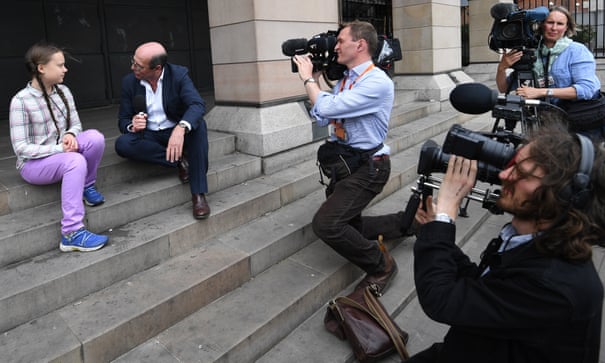
Greta Thunberg is interviewed by Nick Robinson for the Today programme.
Greta Thunberg is interviewed by Nick Robinson for the Today programme. Photograph: Facundo Arrizabalaga/EPA
To get satisfaction from an autistic person’s distress is callous. Like Thunberg, I believe autism can be a gift. It gives me drive and passion and the ability to see through rhetoric and think outside the box, as Thunberg told Robinson. Not every autistic person may feel this way – it’s a broad spectrum. Forty per cent of autistic people have symptoms of an anxiety disorder, such as selective mutism, with which Thunberghas been diagnosed. The same differences that can make autistic people unconventional and innovative thinkers make them vulnerable to bullying, which creates a vicious cycle of anxiety, meltdowns and abuse.
Before I received my diagnosis of autism spectrum disorder, in 2016, it was as if a barrier existed between me and neurotypical people, making us unable to understand each other. Since then, I have been able to develop coping strategies, such as wearing noise-cancelling headphones to reduce the risk of having a meltdown, and I have realised the importance of using my own voice to illuminate the condition. I have also found comfort in learning that there are others, such as Thunberg, who live life on a different wavelength.
If there is any reason to take heart from the blinkered targeting of Thunberg, it is that her opponents are unable to criticise her solely on the grounds of her message. The power of this message exemplifies the value of an unconventional outlook and demonstrates why we need neurodiversity to help create a future worth living in.
• Charlie Hancock is an A-level student from North Yorkshire

day 24 of 30

april is autism acceptance month, so i will be amplifying actual autistic voices

Painting With Broad Brushes: Who Needs a Cure?

“You paint with too broad of a brush. You may not want a cure but the family that struggles with their aged out of the system non verbal in diapers and severe self abuse DESERVE A CURE. Open up your world and see others before you say Autism should not be cured.”

I received the above comment from the grandparent of an autistic child on my “What’s Wrong With Autism Speaks?” video last April.
The idea that my world is not “open”, that I do not think of or consider other autistic people or their families, admittedly hurt me. But ten thousand times worse than the hurt to my personal feelings was the despicable way this stranger spoke about nonverbal autistic people, so confidently asserting their status of non-personhood. Such hate demands response, and sadly, this belief is deeply entrenched in the minds of too many.
Considering that it’s April again, and I’ve been getting questions like this one, I felt that my response was worth sharing. and so I’m posting an edited and updated version here. Content warning for discussions of cure culture and ableism, including abuse and filicide.
You say family members deserve a cure– I say that autistic people and their families deserve better.
Firstly, I did not just say that Autism should not be cured: I said that many autistic people and their families do not think that Autism needs a cure, and also, that Autism can not be cured. My opinion is that focusing on a cure for Autism is harmful and unhelpful, but opinions mean little when what our science knows of autistic neurology says that Autism will never be curable.
Autism will never be curable because Autism is a neurological condition- a developmental disorder- not a disease. Autistic people are autistic from birth. It’s the way we developed and continue to develop throughout our lives. Diseases and illnesses can be cured. Developmental disorders can not. There is no ethical way to change the physical and neurological structure of the brain of a living human being.
Secondly, you say that the families of “non verbal in diapers and severe self [abusive]” autistic people deserve a cure. I say that the insistence on searching for a cure for Autism is not only futile, it is unfair to the very autistic people that you mention.
Discussions of a theoretical “cure” are all about the families of autistic people. When non-autistic people lead the conversation about hypothetical cures, the experiences of actual non-verbal autistic people are erased. When non-autistic people call for a cure, they speak of our alarming existence as disabled people, what burdens autistic people are on our families, how our disabilities make us less than fully human, how our lives are so pitiful as to be not worth living. This dangerous rhetoric, this culture of cure, has real world consequences for the autistic community, which we can see in the truly alarming rise in society-sanctioned filicide of disabled people over the last thirty years. You say family members deserve a cure– I say that autistic people and their families deserve better.
If we are talking about what people deserve: Autistic people deserve to have those millions of dollars that currently go to “research” be redirected towards services and accommodation for autistic people and their families. Currently, the vast majority of that research is focused on finding the “Autism gene”, or on developing a prenatal test for Autism.
Meanwhile, one in a hundred people on this planet have ASD, and two of ten of those people are non-verbal. All live with the burden of ableism, of living in an openly hostile society. Many are mistreated, abused, and oppressed and discriminated against. Autistic people are even murdered, usually by family, simply for being born disabled. Given the circumstances, the frustration of non-verbal autistic people is entirely understandable, and entirely human. And a prenatal test for Autism wouldn’t help any of those autistic people or their families.
The thing to know and understand about self harming behaviours in autistic people, non-verbal and otherwise, is that autistic people don’t self injure because it is an inevitable symptom of Autism, or to make the lives of their loved ones more difficult. Self-injurious behaviour is an expression of a frustration that is unimaginable to people who have never experienced it.
Non-verbal autistic people who can’t speak with their mouths and who have no other way to communicate may self-harm out of deep frustration, in an attempt to control their environment, in an attempt to self advocate. Now, what would happen if some of those millions of dollars currently going towards “research” (which isn’t helping any existing autistic people or their families at all) was instead poured into programs to help non-verbal autistic people communicate via alternative methods?
The thing to know and understand about self harming behaviours in autistic people, non-verbal and otherwise, is that autistic people don’t self injure because it is an inevitable symptom of Autism, or to make the lives of their loved ones more difficult. Self-injurious behaviour is an expression of a frustration that is unimaginable to people who have never experienced it.
Text-to-speech, AAC, the rapid prompting method, sign language– all of these alternative methods have the potential to give non-verbal autistic people the chance to express themselves. And the interesting thing about self-harming behaviour is that it greatly decreases as a person’s ability to communicate and make their needs known increases. Self-harming is an expression of being frustrated, misunderstood, and (as Carly Fleischmann has said) “trapped in a body [they] can’t control”.
Another very important thing to know about autistic people: Wearing diapers does not negate our personhood. Needing a caregiver, aid, or 24/7 supervision does not negate our personhood. Self injury and socially unacceptable forms of stimming do not negate our personhood. No matter what comorbid disabilities, conditions, or circumstances we may be dealing with, we are whole, real people who deserve the same dignity, respect, and civil rights as non-disabled people.
Now, back to the question of cure: Knowing that Autism can never be cured, and that the best we could hope for is a prenatal test to detect Autism in fetuses, it doesn’t really matter who does or who doesn’t think Autism “should” be cured. (It’s autistic people who should get to decide that, anyway). So instead, instead of spending millions of dollars trying to find a genetic marker or prenatal test (a goal that we will probably never achieve), I believe that we should focus on helping actual autistic people who are alive now.
Even if, somehow, magically, autism could be cured- there are so very many autistic people that believe it shouldn’t be. I also believe that a world without autistic people would be a world that has lost something. Autistic people are valuable. Autistic people deserve to exist. Our impairments and our struggles do not negate that. So, that leaves us with a simple conclusion- you’re stuck with us, and what we need is understanding, acceptance, and accommodation.
Along with providing the teaching and technology needed to allow non-verbal autistic people to communicate via alternative methods, putting the money that now goes towards “research” towards the area of “family services” would provide more and better therapies, accommodation, and education for autistic people. That money could also provide services, financial assistance, and respite care for the families of autistic people. Funds directed into these areas would have immediate and life changing impact, particularly for the autistic people and their families living at the points of intersection between ableism and other forms of marginalization, like racism, sexism, and homophobia.
Now that is the kind of fundraising that changes the world.
Image description: Three small signs hammered into the grass lining a paved walking path. The signs are from ASAN Vancouver's protest against Autism Speak's 2016 Walk For A Cure, and they read "Support not cure", "Please stop", and "I am NOT a tragedy".
Further reading
About non-verbal autistic people, and why it’s critical to presume competence:
I Have Nonverbal Autism. Here’s What I Want You to Know.
http://themighty.com/2015/04/i-have-nonverbal-autism-heres-what-i-want-you-to-know/
A list of some nonverbal autistic advocates and their blogs, webpages, or books:
Emma Zurcher-Long
http://emmashopebook.com/

day 23 of 30

april is autism acceptance month, so i will be amplifying actual autistic voices

Kristy Forbes - Autism & Neurodiversity Support Specialist
Do you often find that your autistic child will demand your attention much more when you’re already stressed or busy, rushing or panicking or even chatting or laughing with others?
This is pretty standard behaviour for us autistic people.
Even as adults. Yep, it's true.
The presence people fill rooms and spaces with when they’re busy, rushing, laughing, or having conversations with others generates an energy that can often feel threatening to autistic children.
Excitement, happiness, busy schedules can be as noisy as actual physical noise.
It can bring about an energy that feels unstable, chaotic and disconnecting to us as little people.
The fastest way we find calm and reassurance is to connect with our parents or important people, and when they are not able to provide us with good quality connection, we will take whatever we can get.
Autistic people, of all ages prioritise and prefer CONNECTION over socialisation.
So we go for small snippets of connection with Mum and Dad.
This might look like us asking you the same questions over and over when we already know the answer.
It could be us interrupting your conversations with others in public or when friends and family visit our home.
We might behave in ways we know you will find unacceptable.
Because all of these methods bring about a glimpse of connection with you, which in turn provides us with snippets of reassurance or calm.
Even if you snap.
Even if you yell.
Even if the response is negative.
Anxiety has many faces.
It isn’t always a child shaking, hiding behind her Mother’s skirt, struggling to separate.
It is the child who presents as ‘angry’ or irritable.
It is the child who knocks over or destroys the creations of their peers in educational settings.
It is the child who is late, everywhere, every time.
It is the child who panics over their sock not feeling right.
It is the child with their fingers in their ears, even when the sound isn’t loud..
But the energy, the presence of others, is.
When our autistic children appear to be giving us a hard time,
It is always that they are having a hard time.
And when they appear to be harassing us, provoking us, defying us..
They are more often than not,
Seeking quality connection.
It’s important for us to find the time,
Even two uninterrupted minutes
Of good quality connection
For our little ones.
Because even when they do manage those smaller glimpses of desperate connection,
Our negative, busy, rushed, overwhelmed, exhausted responses
Require recovery time for them as well as us.
A book in the evening,
A cuddle in bed with Mum and Dad.
A cup of tea and a dipping of the bikkie,
And some chit chat about our day.
Some toast together at brekkie,
A silly dance and a laugh.
Receiving a ten minute presentation
On the hunting rituals
Of the North Alaskan seals
Or whatever their current interest might be,
Autistic children want the same thing all children want..
Connection.
They may just seek it out in different ways.
It might not be affection or physical closeness,
But we can always ask:
"How can we spend time together today?"
And allow ourselves the space, time and freedom to
Reconnect us all,
And reinforce the very presence
Our little ones seek.
.
.
.
.
Kristy Forbes
inTune Pathways

day 20 of 30

april is autism acceptance month, so i will be amplifying actual autistic voices

Aut in Sight Aut in Mind
Here’s a thought from me (me being a late diagnosed Autistic woman/Mum of two Autistic children).
In our house, we speak about Autism in a matter of fact way. We acknowledge differences, we acknowledge shared experiences, we acknowledge diversity- including neurodiversity.
We talk about masking/unmasking, we talk about stimming, we talk about the frustration/confusion/overwhelm that arises from a pattern of behaviour being broken in a way that feels unfair, a broken pattern that can never be remedied (this might seem like a random example, but it was drawn from a very tearful conversation with my son a few minutes ago #RecencyEffect).
We link these things to our Autistic Identities; we develop (over time) an understanding that lots of people don’t have the same experience as us and might not understand these things. Not because these things are wrong, but because lots of people aren’t Autistic, and lots of people don’t know much about Autism (yet).
We do this because in knowing ourselves we can know our needs (as a family and as individuals) and move towards finding our Autistic wellbeing, our flavour of flourishing.
I know I am talking about talking, and there are many Autistics who don’t talk in the way I am talking about. Neurodevelopmental divergence indeed results in a range of neurodevelopmental profiles. But please understand that the core message here still applies.
Tiptoeing around Autism and trying not to mention it gives the impression that Autism is something wrong, something shameful, something to be feared and avoided. Matter-of-fact, open dialogue about Autism within the family culture coupled with *developmentally appropriate* information shared with children as they grow in age and readiness can help develop a positive Autistic Identity and support mental health in the long term.
“Fear of a name increases fear of the thing itself” - Dumbledore (book)/ Hermione (movie) but JK Rowling all round.